Introduction Artificial intelligence is rapidly becoming one of the most influential technologies of the modern era. From enterprise copilots and AI agents to research assistants and intelligent search systems, AI is increasingly being used to support critical decisions, business operations, education, healthcare, and knowledge discovery. As AI adoption grows, so does a fundamental question: Can …

Introduction
Artificial intelligence is rapidly becoming one of the most influential technologies of the modern era. From enterprise copilots and AI agents to research assistants and intelligent search systems, AI is increasingly being used to support critical decisions, business operations, education, healthcare, and knowledge discovery.
As AI adoption grows, so does a fundamental question:
Can we trust the outputs generated by AI systems?
Trust has become one of the most important challenges facing the AI industry today.
Organizations deploying AI want systems that are:
- Accurate
- Reliable
- Transparent
- Consistent
- Responsible
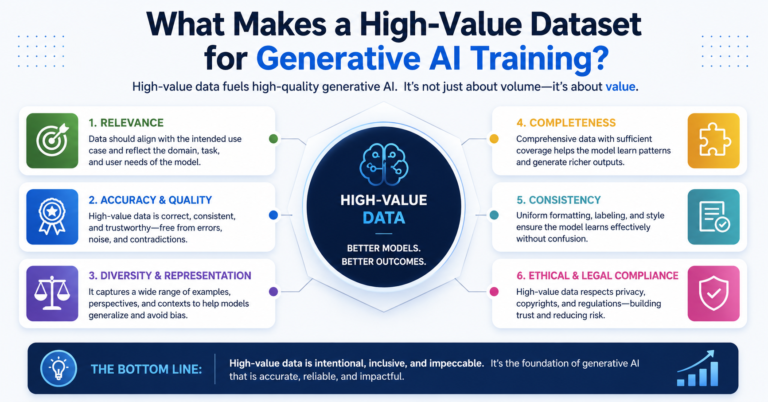
Yet achieving these goals depends heavily on something that often receives less attention than model architecture or computing power: the quality of training data.
The foundation of trustworthy AI begins long before a model is deployed. It starts with the content used to train it.
Increasingly, AI companies are discovering that curated and legally licensed content plays a critical role in building trustworthy AI systems.
What Is Trustworthy AI?
Trustworthy AI refers to AI systems that consistently produce reliable, transparent, and responsible outcomes.
Although definitions vary across industries, trustworthy AI typically includes:
Accuracy
The ability to generate factually reliable responses.
Transparency
Clear understanding of how systems are trained and developed.
Accountability
Defined responsibility for AI behavior and outputs.
Reliability
Consistent performance across different situations.
Compliance
Adherence to applicable legal and regulatory requirements.
Safety
Minimization of harmful or misleading outputs.
Building these characteristics requires more than advanced algorithms.
It requires high-quality data.
Why Training Data Matters More Than Ever
Large Language Models learn patterns from the information they consume.
Every piece of content included in a training dataset influences the model’s understanding of language, facts, reasoning, and human communication.
If datasets contain:
- Inaccurate information
- Spam content
- Contradictory material
- Poorly written text
- Unverified claims
the resulting model may inherit those weaknesses.
This can lead to:
- Hallucinations
- Inconsistent answers
- Reduced reliability
- Lower user confidence
As AI systems become more widely used, organizations can no longer afford to ignore data quality.
Trustworthy AI starts with trustworthy data.
The Difference Between Raw Data and Curated Content
Not all datasets are created equally.
Many early AI systems relied heavily on large-scale internet data collection.
While internet content provides scale, it often includes significant noise.
Curated content takes a different approach.
Rather than collecting everything available, content is carefully selected based on quality, relevance, and reliability.
Curated datasets may include:
- Published books
- Educational resources
- Academic materials
- Professional publications
- Reference works
- Expert-authored content
This focus on quality helps improve model performance.
Why Curated Content Improves AI Reliability
Curated datasets offer several important advantages.
Higher Information Quality
Professional content generally undergoes:
- Editorial review
- Fact checking
- Quality assurance
- Professional proofreading
This creates stronger foundations for machine learning.
When AI systems learn from high-quality information, they are more likely to generate reliable outputs.
Better Knowledge Structure
Books and professional publications often follow logical structures.
Information is presented through:
- Chapters
- Sections
- Explanations
- Supporting evidence
- Conclusions
These structures help AI models understand relationships between concepts.
Reduced Noise
Curated datasets contain fewer low-value examples.
This improves learning efficiency and reduces exposure to misleading information.
Greater Context
Long-form content provides richer context than short internet posts.
This supports:
- Better reasoning
- Improved comprehension
- Stronger contextual awareness
The Role of Licensed Content in Trustworthy AI
Trustworthy AI is not only about quality.
It is also about transparency and accountability.
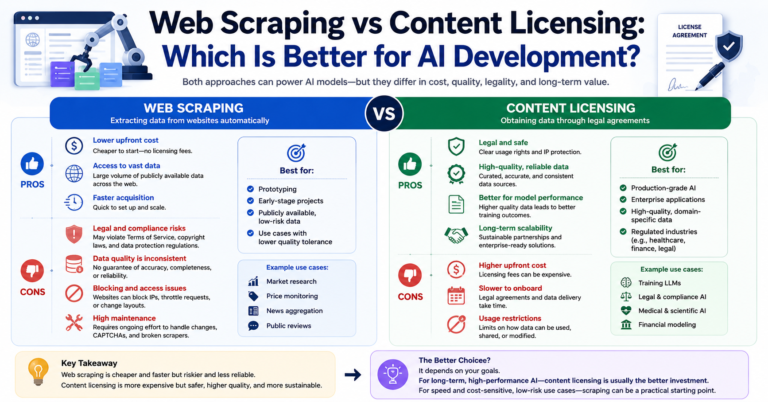
This is where licensed content becomes increasingly important.
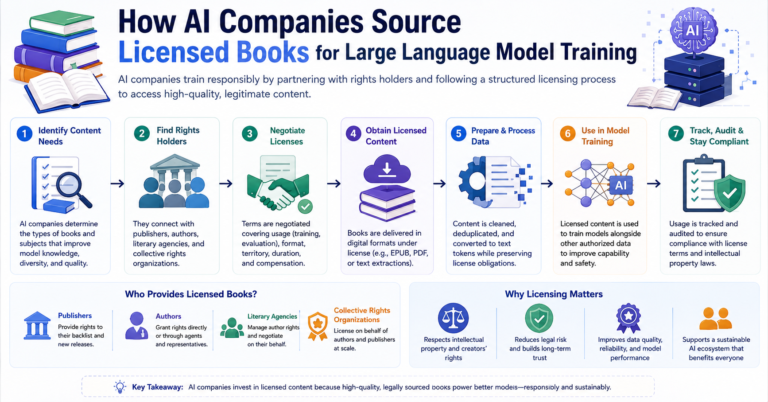
Licensed content is acquired through formal agreements with rights holders.
These may include:
- Publishers
- Authors
- Literary agencies
- Educational organizations
- Research institutions
Such agreements create clear frameworks governing how content may be used.
Why Licensing Matters
The AI industry is increasingly focused on responsible data acquisition.
Organizations are asking:
- Where did the content originate?
- Was it acquired legally?
- Are usage rights clearly defined?
- Can content usage be documented?
Licensed content helps answer these questions.
It provides a transparent foundation for AI development.
Improved Data Provenance
Data provenance refers to understanding where information comes from.
With licensed content, organizations can identify:
- Content sources
- Ownership status
- Usage permissions
- Licensing terms
This level of transparency supports trust and governance.
Reduced Compliance Risk
Organizations deploying AI at scale increasingly face compliance requirements.
Licensed datasets help reduce uncertainty by providing clear usage rights.
This is particularly important for:
- Enterprise AI
- Commercial AI products
- Regulated industries
- Global deployments
Why Enterprises Demand Trustworthy AI
The next phase of AI adoption is being driven by businesses.
Enterprises expect AI systems to support:
- Research
- Customer service
- Knowledge management
- Decision support
- Productivity enhancement
These organizations require confidence in AI outputs.
A hallucinated answer may be inconvenient in a casual conversation.
In a business environment, it can become costly.
As a result, enterprise buyers increasingly prioritize:
Reliability
Can the system consistently produce useful outputs?
Traceability
Can data sources be documented?
Governance
Can usage be monitored and controlled?
Compliance
Can legal obligations be satisfied?
Curated and licensed datasets help address all of these concerns.
How Licensed Books Contribute to Trustworthy AI
Books represent one of the most valuable sources of training content.
Compared with fragmented web content, books offer several advantages.
Deep Expertise
Many books are written by experts with years of experience.
This expertise contributes to stronger knowledge representation.
Editorial Quality
Professional publishing standards improve consistency and reliability.
Long-Form Reasoning
Books help AI models learn:
- Logical progression
- Argument development
- Context retention
- Complex relationships
Diverse Perspectives
Large publishing catalogs often include multiple viewpoints and subject areas.
This diversity helps create balanced datasets.
Responsible AI Starts with Responsible Data Acquisition
The AI industry increasingly recognizes that responsible AI cannot be separated from responsible data sourcing.
Organizations seeking to build trustworthy systems should evaluate:
Content Quality
Is the content accurate and professionally produced?
Rights Management
Are usage permissions clearly defined?
Dataset Diversity
Does the dataset represent diverse perspectives?
Transparency
Can data sources be documented?
Sustainability
Can content access be maintained over time?
These considerations are becoming central to modern AI strategies.
The Competitive Advantage of Trustworthy AI
Trust is emerging as one of the most valuable assets in artificial intelligence.
Organizations that can demonstrate trustworthy practices may gain advantages in:
- Enterprise adoption
- Customer confidence
- Regulatory engagement
- Investor relationships
- Brand reputation
As competition within AI continues to intensify, trust may become a key differentiator.
Models trained on curated and licensed content are often better positioned to support these goals.
The Future of AI Will Be Built on Better Data
The future of AI is not simply about larger models.
It is about building systems that people can rely upon.
Several trends are shaping this future:
Greater Emphasis on Data Quality
Organizations increasingly prioritize quality over volume.
Expansion of Content Licensing
Licensed content is becoming a strategic asset.
Stronger Governance Requirements
Transparency and accountability continue to gain importance.
Enterprise AI Growth
Businesses demand reliable and explainable systems.
Responsible Innovation
Organizations seek sustainable approaches to AI development.
Together, these trends are driving greater interest in curated and licensed datasets.
Building a Trustworthy AI Strategy
Organizations looking to strengthen AI reliability should consider several best practices.
Invest in High-Quality Content
Prioritize professionally created content sources.
Establish Licensing Partnerships
Work directly with trusted content providers.
Maintain Strong Metadata
Improve dataset management and transparency.
Continuously Evaluate Data Quality
Regular reviews help maintain dataset integrity.
Focus on Long-Term Sustainability
Build content acquisition strategies that can scale responsibly.
These steps support stronger and more trustworthy AI systems.
Conclusion
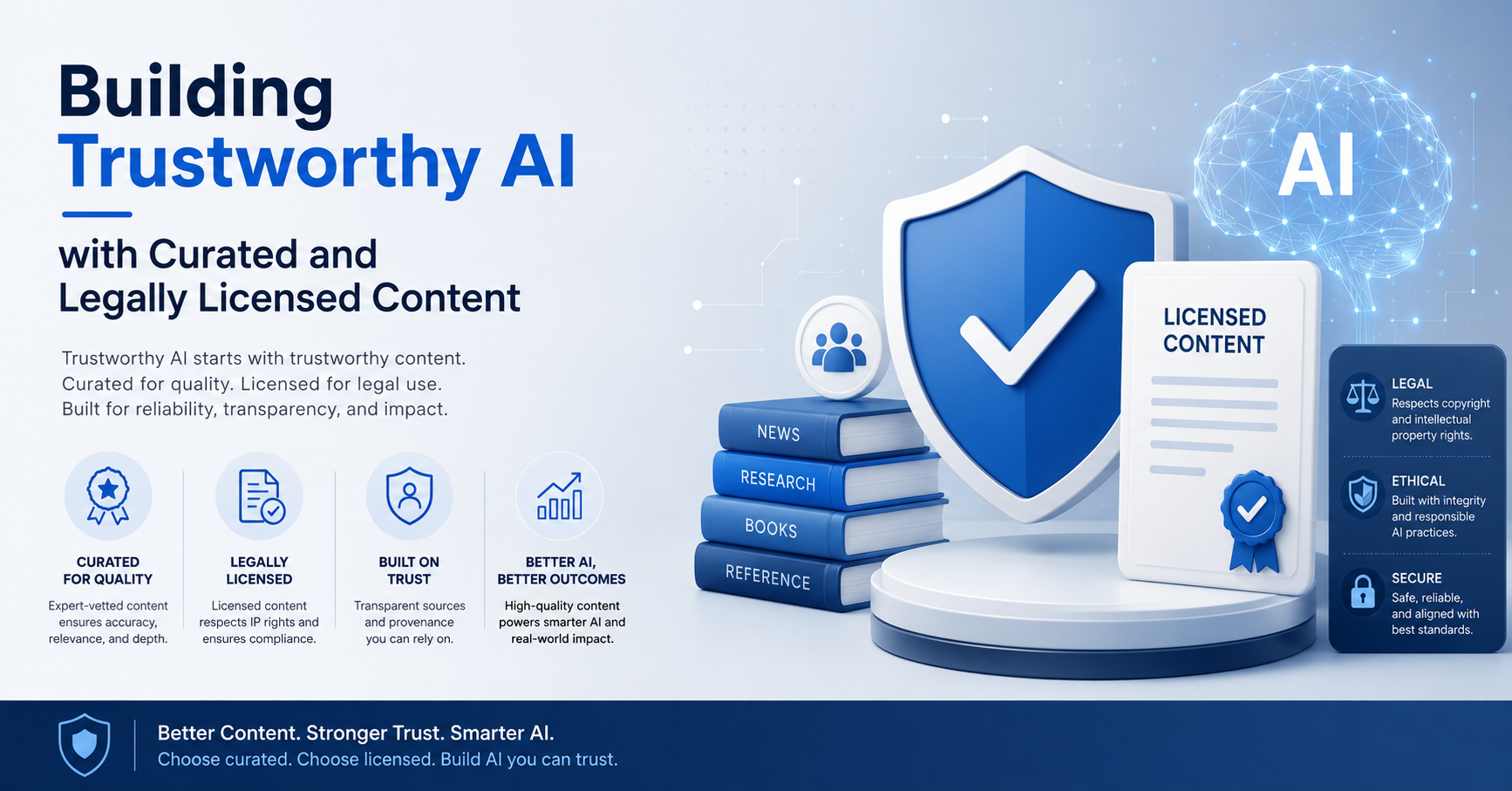
Trustworthy AI begins with trustworthy content.
As artificial intelligence becomes more deeply integrated into business and society, organizations must pay closer attention to the information used during model training.
Curated and legally licensed content provides:
- Higher quality
- Greater transparency
- Better governance
- Reduced compliance risk
- Stronger reliability
These advantages make licensed content increasingly important for AI developers seeking long-term success.
The future of AI will not be defined solely by model size or computational power. It will also be defined by the quality, integrity, and legitimacy of the data behind those models.
Organizations that invest in curated and licensed content today are helping build a more trustworthy AI ecosystem for tomorrow.