Introduction For years, artificial intelligence companies relied heavily on publicly available internet content to train machine learning models. Websites, forums, blogs, and digital archives provided massive amounts of text that could be used to build increasingly sophisticated AI systems. However, the AI industry is now entering a new phase. As Large Language Models (LLMs) become …


Introduction
For years, artificial intelligence companies relied heavily on publicly available internet content to train machine learning models. Websites, forums, blogs, and digital archives provided massive amounts of text that could be used to build increasingly sophisticated AI systems.
However, the AI industry is now entering a new phase.
As Large Language Models (LLMs) become more powerful and more widely adopted, AI companies are discovering that simply collecting vast quantities of internet data is no longer enough. Data quality, legal compliance, content reliability, and long-term sustainability have become critical concerns.
As a result, many AI companies are shifting away from large-scale web scraping and toward strategic partnerships with publishers, content owners, and rights holders.
This transition is creating an entirely new market for licensed content and AI training data.
The Limitations of Web Scraping
When generative AI first emerged, the internet appeared to be an unlimited source of information.
The assumption was simple:
More data equals better models.
But over time, several problems became apparent.
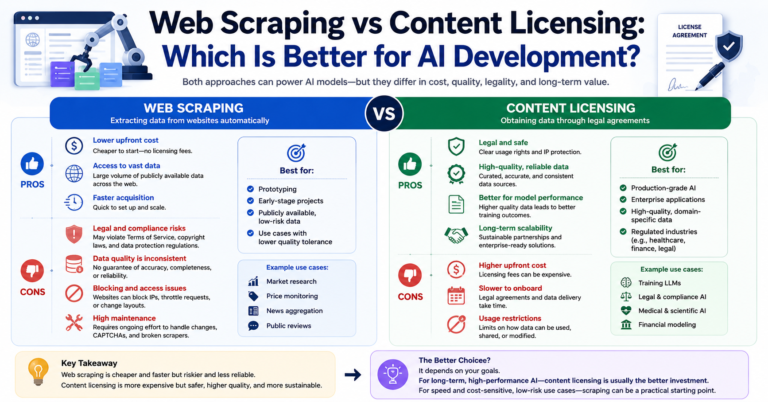
Data Quality Issues
Internet content varies dramatically in quality.
AI systems trained on scraped data often encounter:
- Duplicate content
- Outdated information
- Misinformation
- Spam pages
- AI-generated text
- Poorly edited articles
As models become more advanced, these issues increasingly affect output quality.
A language model is only as good as the data it learns from.
Copyright and Legal Risks
One of the biggest challenges surrounding web scraping is copyright compliance.
Content creators, authors, publishers, and media organizations have raised concerns about the use of copyrighted material in AI training.
For AI companies, this creates significant uncertainty.
Questions such as:
- Was the content legally acquired?
- Can it be used for commercial AI training?
- What rights exist for future model deployment?
have become central to AI development strategies.
Organizations building long-term AI products increasingly prefer datasets with clearly defined rights and licensing structures.
Why Publishers Offer a Better Alternative
Publishers have something AI companies desperately need:
High-Quality Human-Created Knowledge
Unlike random internet content, professionally published books undergo:
- Editorial review
- Fact-checking
- Quality control
- Professional writing processes
This makes published content significantly more valuable for training advanced language models.
Books often contain:
- Deep subject expertise
- Long-form reasoning
- Rich vocabulary
- Structured narratives
- Contextual understanding
These characteristics help improve AI model performance.
The Rise of Licensed AI Training Data
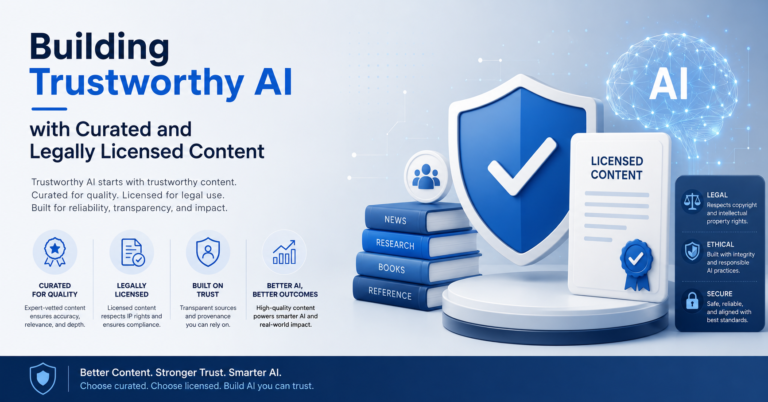
The AI industry is increasingly recognizing that licensed content provides several advantages.
Legal Certainty
Licensed datasets provide clear usage rights.
Instead of operating in legal gray areas, AI companies can obtain content through formal agreements that define:
- Usage permissions
- Training rights
- Geographic scope
- Commercial rights
- Renewal structures
This reduces risk and improves long-term business stability.
Higher Dataset Quality
Curated publisher content generally contains:
- Better grammar
- Better structure
- More accurate information
- Stronger contextual relationships
For AI developers, quality often matters more than volume.
A smaller collection of high-quality licensed content may outperform massive quantities of unverified web data.
Why Books Are Particularly Valuable for LLM Training
Books represent one of the richest sources of human knowledge ever created.
Unlike short-form web content, books provide:
Long Context Windows
Books teach AI systems how ideas develop across hundreds of pages.
Advanced Reasoning
Complex arguments and detailed explanations improve reasoning capabilities.
Domain Expertise
Books often contain knowledge written by specialists with decades of experience.
Narrative Understanding
Stories help models understand:
- Character development
- Human emotions
- Cause and effect
- Long-term context
These capabilities are increasingly important for modern AI systems.
The Emergence of AI Content Licensing Marketplaces
As demand grows, a new ecosystem is emerging.
Content licensing platforms now help connect:
Content Suppliers
- Publishers
- Authors
- Literary agencies
- Academic organizations
with
Content Buyers
- Foundation model developers
- Enterprise AI companies
- Research organizations
- Generative AI startups
These marketplaces simplify the process of discovering, licensing, and managing training datasets.
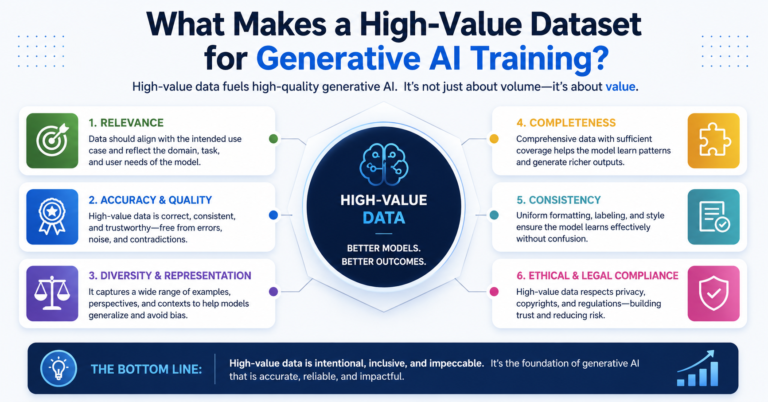
What AI Companies Look for in Licensed Content
When evaluating content for training purposes, AI companies typically prioritize:
Scale
Large collections covering diverse topics.
Quality
Professionally edited content.
Rights Clarity
Clearly defined licensing agreements.
Diversity
Different genres, subjects, and perspectives.
Freshness
Regularly updated content collections.
Publishers that can provide these characteristics are becoming increasingly attractive partners.
The Future of AI Training Data
The next generation of AI models will likely depend less on uncontrolled internet scraping and more on licensed, curated, and rights-compliant datasets.
Several trends support this shift:
- Increased regulatory scrutiny
- Growing copyright awareness
- Demand for trustworthy AI
- Enterprise adoption requirements
- Higher model quality expectations
As AI becomes a core business technology, organizations need data sources that are sustainable, transparent, and legally defensible.
Licensed content addresses all of these requirements.
Conclusion
The AI industry is undergoing a fundamental transformation.
The question is no longer how much data can be collected.
The question is whether that data is reliable, legally usable, and capable of supporting next-generation AI systems.
Publishers possess some of the world’s highest-quality collections of human knowledge, while AI companies require trusted datasets to build increasingly sophisticated models.
This alignment is creating a powerful new content economy based on licensing rather than scraping.
Organizations that embrace licensed content today are positioning themselves for a future where quality, trust, and compliance are just as important as scale.
Bookscape connects AI companies with high-quality, rights-cleared content from publishers, authors, and content owners worldwide.
Contact our team to explore licensing opportunities and discover datasets tailored for Large Language Model training and Generative AI development.